Software & SaaS·Global
Domain: workos.comCurrent status
WorkOS is reporting normal operation
OPERATIONAL (PROVIDER REPORTED)
Why this status
Provider status feed reports operational.
- Provider feedProvider status feed reports operational. · checked
- Our probesNo probe results yet.
- Visitor reportsNo visitor reports in the last hour.
Reports, last hour
0
No reports
Reports, last 24 hours
0
0 in the last hour
90-day total
0
Normal: 0.00 per 15 min
Status source
Provider status feed
Last checked Nov 27, 6:44 PM UTC
Reports, last 24 hours
30-minute buckets, UTCNo reports for WorkOS in the last 24 hours.
How this page works
Status for WorkOS comes from the provider's own status feed where one exists. Visitors can also report problems, and reports are counted per day. Incident history is what the provider published, kept for a year; uptime is computed from the status changes we observed.
Components
from the provider's status page
All 7 WorkOS components are reporting normal operation.
- AuthKitOperational
- DashboardOperational
- Admin PortalOperational
- SSOOperational
- Directory SyncOperational
- Audit LogsOperational
- FGAOperational
Components can change independently during a partial outage.
Uptime
Measured by us from the status WorkOS publishes, over the 7 days we have watched it. Degraded performance counts as up; only a major outage counts as down. Days we did not observe are left out, not counted as perfect.
- 100%
- Last 24 hours
- 100%
- Last 7 days
- 98.1% fully operational
- 100%
- Last 30 days
- 98.1% fully operational
- watched 164 h of this
- 100%
- Last 90 days
- 98.1% fully operational
- watched 164 h of this
90 days agotoday
Fully operationalSome degraded timeSome major outage timeNot observed, but the provider recorded an incidentNot observed
Visitor reports
from people using this siteVisitors can say they are having a problem with WorkOS. Reports are anonymous, limited to one per service every 15 minutes per person, and kept for 90 days. They are not verified, so read them alongside the status and response time above.
Nobody has reported a problem with WorkOS in the last 30 days.
Follow WorkOS
free, no accountSlack or Discord alerts
Paste an incoming-webhook address and we post a message when WorkOS changes status. A change is sent only after it has lasted 5 minutes, so a one-minute blip stays quiet.
Anyone with the webhook address can post to your channel, so only paste your own. We keep it only to send these alerts.
Feed and API
Add the feed to any reader. A new update to an incident arrives as a new entry.
Status badge
Show WorkOS's live status on your own page or in a README.

HTML
<a href="https://securlabs.org/status/workos"><img src="https://securlabs.org/badge/workos.svg" alt="WorkOS status"></a>
Markdown
[](https://securlabs.org/status/workos)
Incident history
WorkOS's own incident record, with every update the provider posted. Longest resolved incident here: 4h 19m.
Elevated latency and errors for AuthKit and User Management API
· lasted 1h 16m
major impactResolvedAffected: AuthKit
4 updates
postmortem ·
# Elevated latency and errors for AuthKit and User Management API Date: 11/24/2026 Duration: 05:14–05:33 UTC \(19 minutes\) Status: Resolved ## Summary On November 24, 2026, from 05:14 to 05:33 UTC, WorkOS experienced elevated latency and errors in AuthKit and the User Management API. Customers saw slow or failed sign-ins, failed session refreshes and token exchanges, and failed or slow User Management API requests. SSO requests made directly through the SSO API and Directory Sync were not affected. A database column had recently been added to a high-traffic table with a different index pattern than its siblings, designed to improve performance. A production deployment referencing the new column landed before the table had statistics available for the change, causing the database to choose an inefficient plan involving a sequential scan. Each lookup took up to about 30 seconds, which exhausted the database connections available to the service and caused unrelated requests to queue and fail. On-call engineers were alerted to the latency spike and we rolled back the deployment. Service returned to normal by 05:33 UTC. This was caused by a change we shipped to a critical sign-in path. We take responsibility for the impact and for the delay in updating our status page. ## Background When a user signs in with a social or enterprise identity provider, AuthKit looks up which user is linked to that provider profile. Adding support for new providers involves adding new database columns. ## What Happened ### Affected products * AuthKit: Sign-in, sign-up, session refresh and token exchange, including OAuth and MCP clients that rely on refresh tokens. * User Management API: Requests served by the same service, including user info and invitation requests. * Not affected: SSO connections made directly through the SSO API, and Directory Sync. ### Customer impact * Scope: Between 05:14 and 05:33 UTC, measured at our edge, 46% of User Management API requests failed or timed out \(18% returned server errors and 27% were abandoned by the client after waiting\), and 32% of AuthKit requests failed or timed out \(9% returned server errors and 23% were abandoned by the client after waiting\). There were no comparable errors in the period before the deployment. * Symptoms: Requests either failed with HTTP 5xx errors or took tens of seconds. 75th-percentile latency rose from about 60 milliseconds before the deployment to about 45 seconds at the worst point. * Scale: Some customers saw almost all of their refresh-token exchanges fail during the window, which signed out some of their users and connected clients. Failed or abandoned request rates measured at our edge, per minute, from 04:50 to 06:00 UTC. Errors began at 05:14 UTC and returned to baseline at 05:33 UTC: 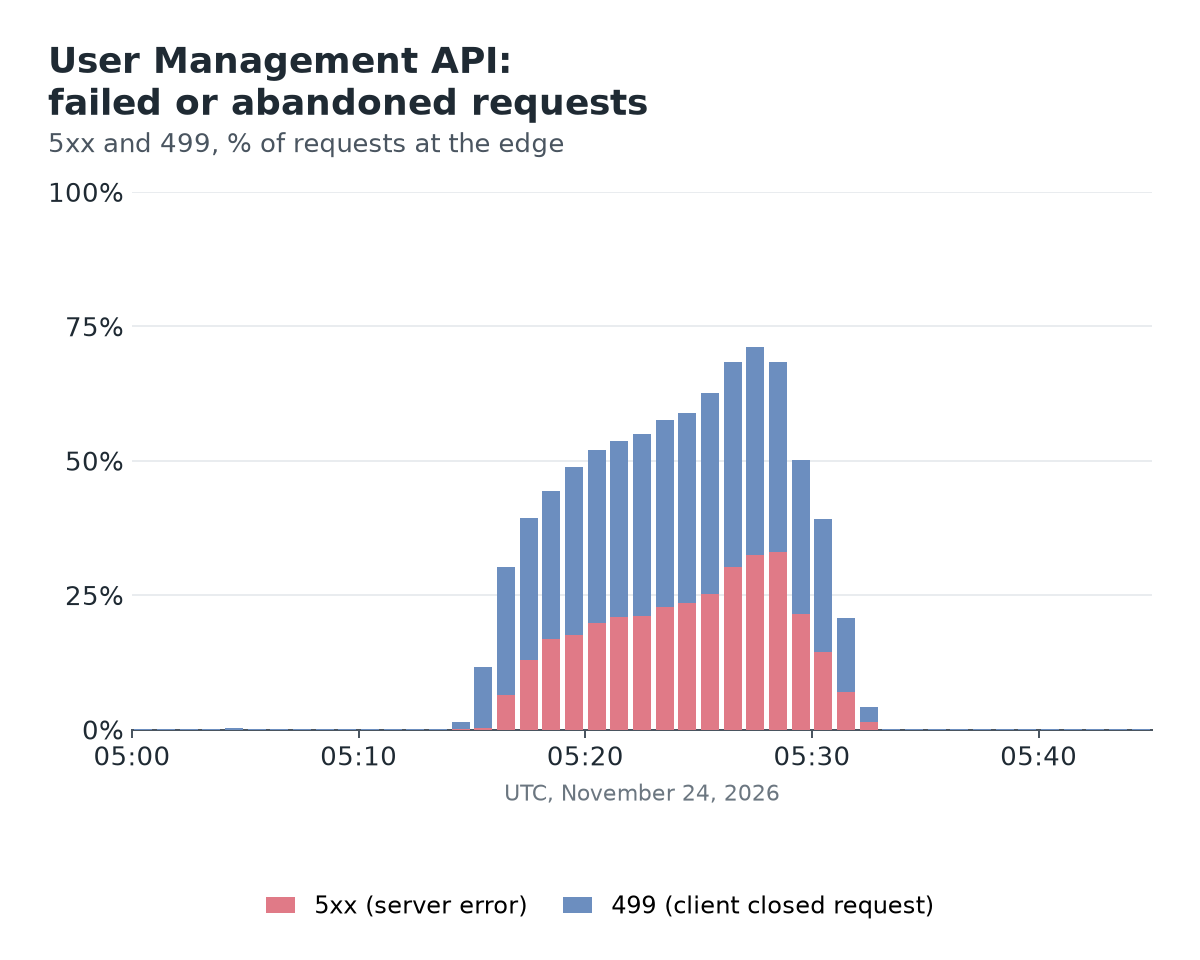 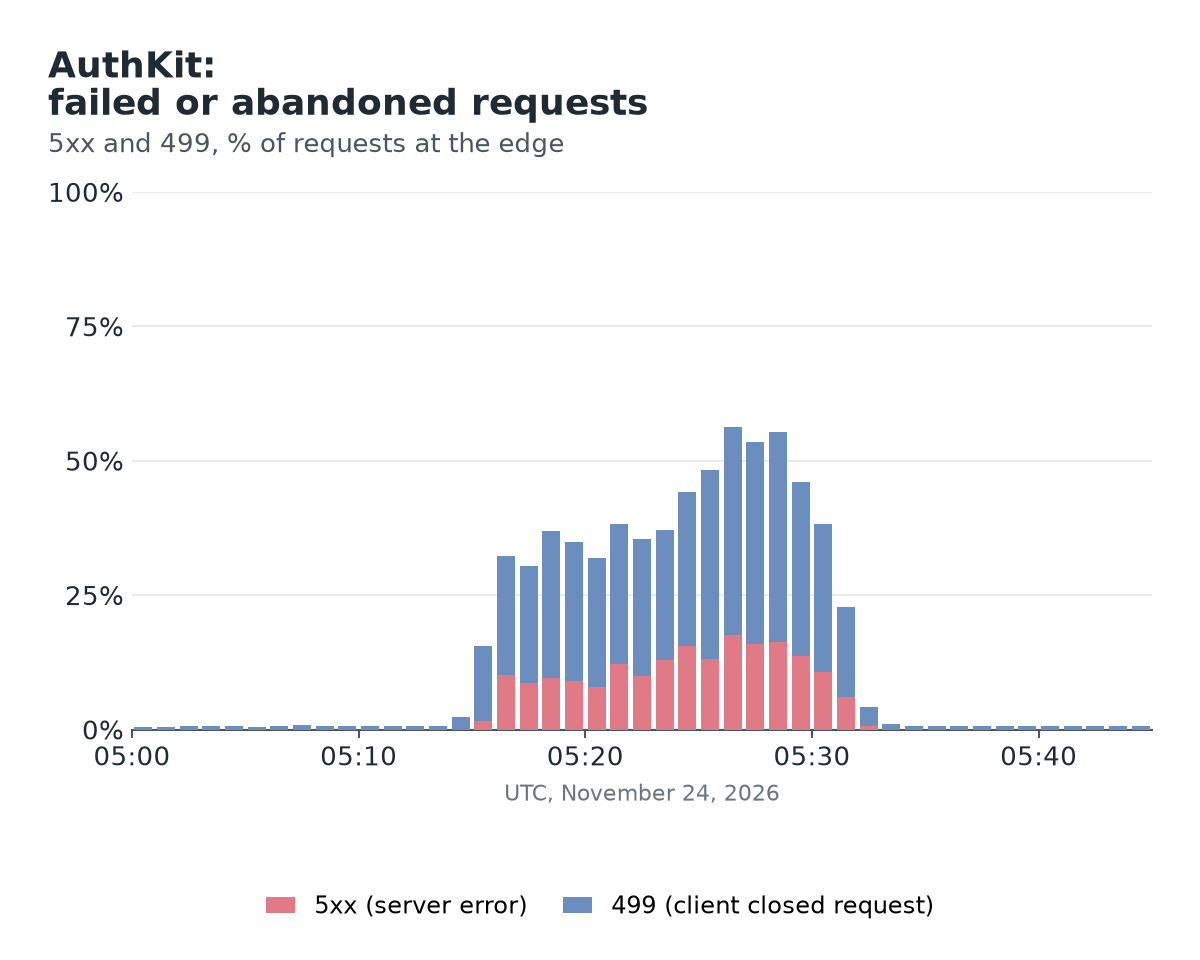 Failed or abandoned requests by endpoint, listed by traffic, highest first: 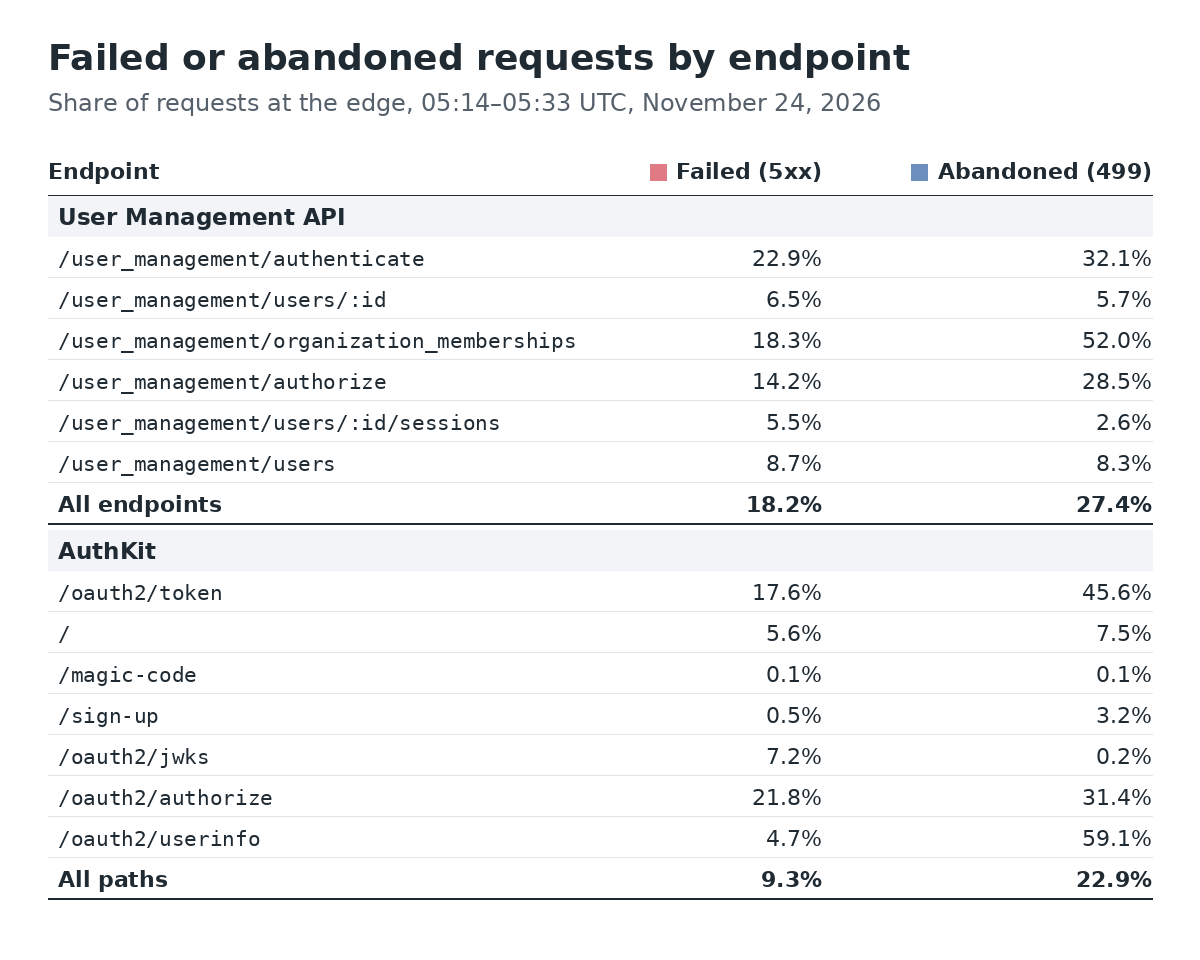 ### Root cause The deployment added support for a new OAuth provider, updating the sign-in lookup to check a new column. The column had been created in the database about thirteen hours before the code change landed. 1. No statistics for the new column. Automatic statistics collection had not yet run on the table after the column was added. 2. A slow query plan. The new column's index covered only rows with a value, a pattern we chose to make reads and writes faster. Until statistics existed for the new column, the database couldn't use that index to tell that a match was unique. It estimated a large number of matching rows, rather than one or zero, and chose to scan the table instead of using the index. Each lookup took up to ~30 seconds. 3. Connection exhaustion. Each slow lookup held a database connecti
resolved ·
Between 05:14 UTC and 05:33 UTC on November 24 we saw elevated latency and errors in AuthKit and the User Management API, including slow or failed sign-ins, session refreshes, and API requests. We identified the cause, rolled back the change, and all services have been operating normally since 05:33 UTC. We’re sorry for the disruption this caused you and your users. We’ll share a full root cause analysis once our investigation is complete.
monitoring ·
We've resolved the issue that caused elevated latency and errors for AuthKit sign-ins and the User Management API. We're continuing to monitor and will post another update soon.
investigating ·
Update (Identified): We've identified the cause of elevated latency and errors affecting AuthKit sign-ins and the User Management API, starting at 05:14 UTC. Some requests are slow, and some are failing with timeouts or 5xx errors. End users may see errors when signing in. A recent change is responsible, and we're rolling it back now. SSO connections made directly through the SSO API and Directory Sync are unaffected. We'll post another update once the rollback completes, within 30 minutes at the latest.
Delayed or failed emails for custom email domains
· lasted 1h 48m
minor impactResolvedAffected: AuthKit
3 updates
resolved ·
This has now been resolved by the upstream provider, and errors have subsided.
monitoring ·
We are seeing recovery, in alignment with what our upstream email provider is reporting, and we are monitoring the ongoing recovery.
investigating ·
Some emails sent from custom email domains are delayed or not delivered. This includes sends through customer-configured SendGrid accounts. The issue comes from elevated errors at our upstream email provider. Affected emails include Magic Auth codes, password resets, email verifications and invitations. Users who don't get an email may need to request it again. Emails sent from the default WorkOS domain don't appear to be affected. We're working with our provider and will post another update within 60 minutes or as soon as we know more.
Elevated AuthKit errors
· lasted under a minute
ResolvedAffected: AuthKit
1 update
resolved ·
For about 62 seconds, from 2026-11-22 05:31:27 to 2026-11-22 05:32:28 UTC, we experienced elevated error rates for AuthKit API requests. Error rates have since returned to normal.
Email delivery delays
· lasted 2h 22m
minor impactResolvedAffected: Dashboard, AuthKit
3 updates
resolved ·
Email delivery metrics have returned to baseline, and recent checks show no elevated delivery delays.
monitoring ·
We've remediated the issue and we're seeing email delays returning to normal levels. We'll continue monitoring.
investigating ·
Some WorkOS emails to Gmail and Google Workspace addresses, including sign-in codes, have been arriving several minutes late. Mail to other providers is not affected. Delayed messages are retried automatically, and we're working to restore normal delivery.
Elevated latency and errors for SSO sign-in
· lasted under a minute
Resolved1 update
resolved ·
From 09:48 to 09:53 UTC on November 13, 2026, SSO sign-in requests were slow, and a small number failed with HTTP 500 errors or 408 timeouts. The slowdown affected SSO authorization, identity provider callbacks and token exchange.
Elevated AuthKit API Error Rates
· lasted 1h 8m
major impactResolvedAffected: AuthKit
4 updates
resolved ·
This incident has been resolved.
identified ·
We are continuing to work on a fix for this issue.
identified ·
The issue has been identified and a fix is being implemented.
investigating ·
We are investigating elevated error rates affecting AuthKit endpoints.
Elevated latency and errors for AuthKit API requests
· lasted 1h 0m
minor impactResolvedAffected: AuthKit
3 updates
resolved ·
This incident has been resolved.
monitoring ·
From 19:35 to 19:49 UTC AuthKit API request latency and error rates were elevated. Service has since recovered fully and we are monitoring.
investigating ·
We are seeing elevated latency and error rates in AuthKit authentication flows.
Intermittent 503 errors in certain regions
· lasted 4h 19m
minor impactResolvedAffected: Dashboard, AuthKit
5 updates
resolved ·
This incident has been resolved.
monitoring ·
Our upstream provider has mitigated the issue affecting those edge regions and 503 error rates have returned to normal.
identified ·
We continue to see intermittent 503 errors on a small fraction of requests routed through Ashburn, Virginia. We continue to work with the upstream provider.
identified ·
We continue to see intermittent 503 errors on a small fraction of requests routed through certain regions, primarily Ashburn, Virginia. We will provide updates as they become available while we work with our upstream provider.
identified ·
We're seeing intermittent 503 errors on a small fraction of requests routed through certain regions, primarily Ashburn, Virginia. We've isolated this to an issue with an upstream provider and are working with them on a resolution.
Similar services
Services in the same group as WorkOS, with their status right now.
WorkOS status: common questions
- Is WorkOS down right now?
- Right now WorkOS is operating normally. Provider status feed reports operational. This page refreshes as our checks and the provider's status feed update, so you are not reading a stale answer.
- What should I do if WorkOS is not working?
- First check the status and component list above to see whether your problem matches a known issue. Then press the test button to see if WorkOS answers from other countries: if it does, the problem is probably your network, so try another connection, restart your router or device, and clear the app or browser cache. If it is down everywhere, wait for the provider's updates in the incident history or follow the feed, and use any fallback you have until it recovers.
- How often does WorkOS have problems?
- In the last 90 days WorkOS's own status page recorded 8 incidents. 2 of them were rated major or critical impact. The longest resolved one lasted 4h 19m and the average was 1h 42m.
- What usually goes wrong with WorkOS?
- Looking at the last 90 days of incidents, the parts of WorkOS named most often were AuthKit (7), Dashboard (2).
- Where does this status come from?
- From WorkOS's own status page, which we read about every minute. We also run our own check of its website, and count problems reported by visitors here. We show each of these separately under "Why this status" so you can judge them yourself.
- Can I get an alert when WorkOS goes down?
- Yes, free and without an account. Use the Follow section to post alerts to Slack or Discord, subscribe to the feed in any reader, or call the public API. A change is only announced after it has lasted five minutes.
Sources
- WorkOS status page The provider's own status page. This is where the status above comes from.
- Our probeOne request every one to five minutes to the address below, timing DNS, connection, TLS and the first response.
- Globalping When our probe fails, or when you press the test button, one request is sent to the service from six countries. Probes are run by the Globalping network (jsDelivr).
- Visitor reportsProblems reported by visitors on this site, counted per 15 minutes and compared with this service's own normal level.